


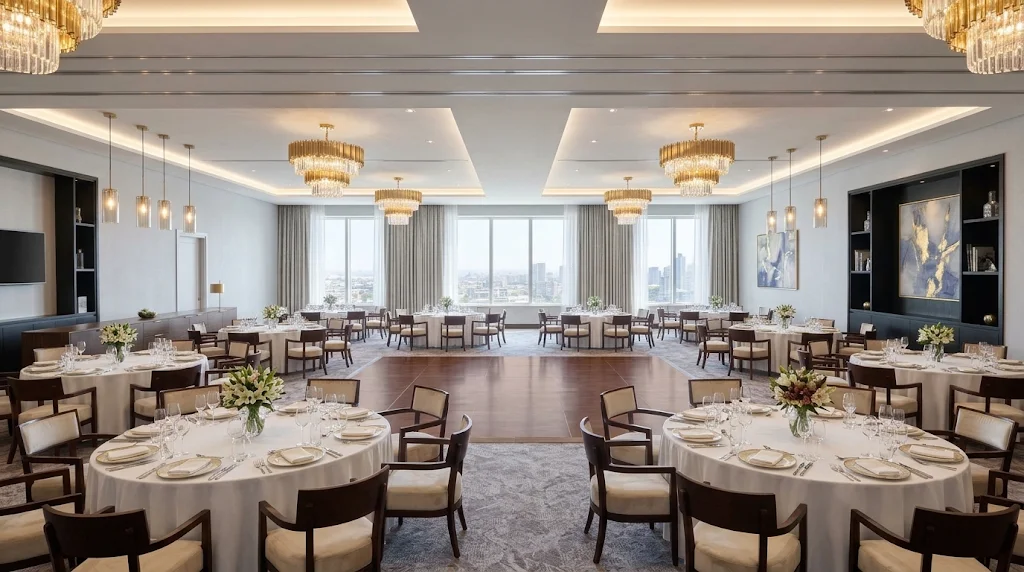
Banquet hall hotel furniture lives a harder life than almost anything else in the building. In a single week the same room may host a wedding for two hundred, a product launch with a stage, and a training session laid out classroom-style. The furniture is set, reset, dragged, stacked, and stored by staff who are working against a clock. After more than 25 years manufacturing loose and fixed furniture for five-star hotels and resorts, we have learned that banquet furniture is not judged on how it looks on the opening night — it is judged on how it performs at the four hundredth changeover.
That reality changes the specification. A chair that photographs beautifully but loses its stacking feet after a season becomes a maintenance problem across hundreds of units. A table that is stable when new but racks after a year of trolley movement turns every event setup into a negotiation with the floor. This guide covers what banquet hall hotel furniture should be specified against, how to plan flexibility without sacrificing durability, and the details that separate a set that lasts from one that merely arrives.
Specify the changeover, not the ceremony
The first question in a banquet project is rarely "what style?" It is "how many times a week does this room change layout, and who moves the furniture?" The answer determines nearly everything: the weight of the tables, the stacking height of the chairs, how much storage the back-of-house can absorb, and whether the finish will survive being pushed rather than carried.
We ask clients to map three or four real event scenarios before the specification is fixed: a formal wedding with round tables of ten, a conference with long rows, a standing reception, and a smaller breakout layout. If the same stock has to serve all four, the furniture must be modular, consistent in height, and light enough for a two-person crew to move safely. A set designed only for the wedding photograph will fail the Tuesday morning conference.
This is also where banquet hall hotel furniture differs from restaurant furniture. A restaurant keeps its layout for months; a banquet hall may rebuild its layout twice a day. The specification should assume repeated handling as the normal condition, not the exception.
Tables: stability, edge protection, and a common height
Round tables dominate banquets because they let guests talk across the table, but the shape is only half the decision. The frame and the folding mechanism matter more. A table that locks firmly when open and folds flat when stored will outlast one with a lighter mechanism, even if the lighter one is easier to move on day one.
Three details deserve attention at specification stage. First, a consistent table height across the whole stock, so linens, skirts, and chair heights all work together without adjustment. Second, edge protection: a solid bullnose or a replaceable edge band protects the table from trolley impact and prevents the chipping that makes a linen sit unevenly. Third, the locking mechanism — it should be positive, visible, and serviceable, so a worn latch can be replaced rather than condemning the table.
For rectangular tables used in conference layouts, the same logic applies with one addition: the leg position must allow chairs to tuck in without trapping knees, and the tables must align precisely when placed in rows. Inconsistent dimensions turn a clean classroom layout into a jagged one, and that is what guests notice in the photographs.
Chairs: stacking load and frame construction
A banquet chair is a structural component, not a decorative one. It is stacked, unstacked, dragged across a floor, and sat on by guests of every size. The frame should be welded or jointed to hospitality grade, with a stacking design that transfers load through the frame rather than through the upholstery. When chairs are stacked, the weight of the stack must rest on the frame and the stacking rails, never on the seat cushion.
Check the feet and the stacking contact points first, because that is where wear appears. Replaceable glides protect both the chair and the floor; integrated nylon pads that wear through in a season create a maintenance backlog across hundreds of units. Ask whether the glide is a service part, and whether the supplier can supply replacements in the same finish.
Upholstery choice follows the same logic. A banquet chair seat takes spills, cleaning chemicals, and constant compression at the front edge. A contract-grade fabric over a dense foam, built to the fire standard of the market, will hold its shape far longer than a softer decorative combination. When you review casegood and soft seating sets, ask to see the full build-up rather than the cover alone.
Storage and back-of-house discipline
Every banquet set spends part of its life in storage, and that is where much of the damage happens. Chairs stacked too high, tables leaned against a wall, trolleys loaded beyond their rating — the wear is often caused by the storage plan rather than the event. The furniture specification should be matched to a storage plan that the operations team has actually walked through.
- Plan the stack height against ceiling clearance and trolley capacity, and mark the maximum on the wall so staff do not improvise.
- Provide a dedicated trolley for tables and another for chairs; mixed loads are how edges and frames get damaged.
- Keep a small buffer stock of glides, stacking feet, and table latches, so a single worn part does not take a table out of service.
- Train the set-up crew once, then post the method; consistent handling prevents the drift that turns a matched set into a mixed one.
A set that stores well also lasts longer, because it is handled less violently between events. That is a design outcome, not an operational accident.
Fabric, finish, and the realities of high-turnover events
Banquet upholstery is exposed to red wine, coffee, candle wax, and cleaning agents, often within the same evening. The fabric should be specified for cleanability as well as appearance, and the finish on tables should resist heat and alcohol rings. A matte lacquer that looks refined in a showroom may mark badly under a hot serving dish; a commercial laminate or a catalyzed finish may be the more honest choice.
Where the design calls for a richer look, we often recommend a two-tier approach: a premium finish on the tables that guests see at eye level, and a more forgiving finish on the surfaces that take the trolley traffic. The room still reads as designed, but the maintenance burden is concentrated where it can be managed.
Fire performance is not optional in an assembly space. Depending on the market, the applicable standard may be CAL 117, CAL 133, TB 133, EN 1021, or BS 5852, and the certificate should be tied to the actual fabric and foam build used. A generic certificate for "similar" materials is not evidence. Ask for documentation against the specific combination.
A sourcing checklist for banquet hall hotel furniture
| Item | What to confirm |
|---|---|
| Table mechanism | Positive lock when open, serviceable parts, consistent height across the stock |
| Chair stacking | Load carried on frame and rails, replaceable glides, stated maximum stack |
| Fabric | Contract-grade cleanability plus fire certification for the exact build-up |
| Finish | Heat and alcohol resistance on serving surfaces, touch-up availability |
| Storage plan | Trolleys, stack limits, and back-of-house space agreed before the order |
| Spares | Glides, feet, latches, and matching fabric available after completion |
Why flexibility is a specification, not a wish
Most banquet briefs ask for "flexible furniture" without defining what flexibility means. In practice it means a small number of interoperable pieces: one round table size, one rectangular size that matches it in height, chairs that work at both, and a storage system that keeps them matched. Every extra variant multiplies the storage, the training, and the maintenance.
We recommend limiting the range deliberately. A property with two table types and one chair family can reset faster than one with five variants, and the crew makes fewer mistakes under pressure. Flexibility comes from how the pieces combine, not from how many different pieces exist.
Frequently asked questions
How many banquet chairs should a hotel hold?
Enough for the largest seated event plus a working buffer for damage and double setups. The buffer matters more than the theoretical maximum, because a shortfall on the day cannot be solved.
Are round or rectangular tables better?
Both, in a deliberate ratio. Round tables suit weddings and dinners; rectangular tables suit conferences and long layouts. Specify a common height so linens and chairs work across the set.
What is the most common banquet furniture failure?
Worn glides and stacking feet, followed by table latches. They are small, cheap parts that take the whole piece out of service when they fail — which is why spares should be part of the order.
Can banquet furniture be matched to the hotel's design scheme?
Yes. Frame shapes, wood finishes, and fabric can be specified to the interior concept, as long as the structural and fire requirements are not traded away for appearance.
Should we buy from the same supplier as the guestroom furniture?
Usually yes, when the supplier covers both scopes. One finish library and one delivery schedule reduce mismatches, and one accountable party simplifies the install and the close-out.
Banquet hall hotel furniture is an operations decision disguised as an interior decision. Specify for the changeover, keep the range deliberately small, protect the parts that wear, and plan the storage before the order. Do that, and the room still looks composed at the four hundredth event — not just the first.
Why global hospitality teams work with OC International
OC International (OCI) has manufactured loose and fixed furniture for five-star hotels, resorts, and serviced residences since 1997. From our manufacturing base in Dongguan we support owners, developers, design firms, and FF&E consultants across the Americas, the Middle East, and Asia with one accountable team covering design development, production, quality control, packing, shipping, and on-site installation.
What our manufacturing base delivers
- In-house casegoods, soft seating, millwork and joinery under one roof — one specification, one documented quality system, one point of accountability.
- Builds engineered to the fire-safety and emissions standards your market requires — CAL 117, CAL 133, TB 133, EN 1021, BS 5852, FSC timber, and CARB P2 — under an ISO 9001-controlled production process.
- Prototype-to-volume discipline: a signed mock-up is the reference standard every production order is measured against.
- Coordinated logistics and installation that keep multi-room-type properties on a defined delivery sequence and a protected opening date.
Selected delivered projects
Our furniture has been delivered to landmark properties including the Fairmont Austin, Four Seasons Chicago, Sheraton Dhaka, Marriott Sydney, Conrad Los Angeles, and Hilton DoubleTree projects across multiple regions — each specified to the operator's brand standard and installed to opening.
Planning banquet hall hotel furniture for a room that resets several times a week?
See public area furniture sets Send your event layoutsYour email address will not be published. Required fields are marked *